Flexibility Aggregation
Flexibility Aggregation
Flexibility matching is the process by which buy bids and sell offers are paired in the market. Matching operates across two domains simultaneously: quantity (or power) and time.
The market currently fulfills seller asks completely against buyer bids — a sell order is always consumed in full when matched. However, a single large buyer bid may be matched against several smaller seller offers, which means the bid must be progressively split during the matching process.
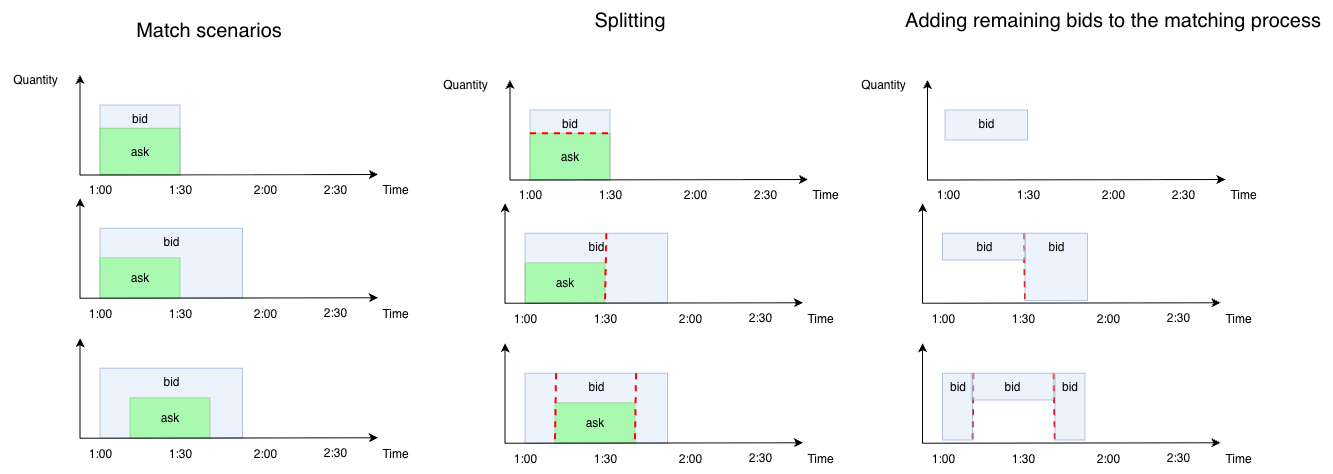
Splitting a Bid
´´´´´ Whenever a bid is matched with a sell order, the bid is divided:
- The portion covered by the sell order is consumed.
- The remaining portions are split into one or more smaller bids and re-entered into the matching process.
Depending on the degree of overlap in the time domain and the quantity (power) domain, a bid is split into a minimum of one new bid with a shorter time duration, and up to two or three new bids.
Split Strategies
There are two fundamental approaches to splitting a bid during continuous matching.
Option 1 — Time-Domain Split
The bid is divided first along the time axis. The matched interval (where the sell order overlaps in time) is separated from the remainder. This produces sub-bids that cover distinct, non-overlapping time windows.
Figure 1
Image to be added: illustration of a bid split along the time axis.
Option 2 — Quantity (Power) Domain Split
The bid is divided first along the quantity (power) axis, as specified in the initial order. The matched quantity is separated from the unmatched quantity. Sub-bids with distinct power levels but potentially overlapping time intervals are re-queued.
Figure 2
Image to be added: illustration of a bid split along the quantity/power axis.
Resulting Sub-Bids After a Match
After a sell order is consumed by a bid, the remaining unmatched portions are returned to the queue as new, smaller bids. The number of resulting sub-bids depends on the spatial overlap of the original bid and the sell order in both domains:
| Overlap scenario | Resulting new bids |
|---|---|
| Full overlap in both domains | 0 new bids (bid fully consumed) |
| Partial overlap in one domain only | 1 new bid (reduced time or quantity) |
| Partial overlap in both domains | 2–3 new bids |
This process repeats continuously until the original bid is fully matched or no suitable sell orders remain.